
Fairfield Township City Directory Holdings
Fairfield Township did not develop as a self-contained city directory market. It was an agricultural township that later became suburban, and nearby Hamilton and county sources often carry the historical trail. Lane Libraries Local History and Genealogy identifies the Smith Library of Regional History and Cummins Local History Room as Butler County repositories for directories, yearbooks, maps, newspapers, photographs, city records, and Fairfield history material. Ask staff for Hamilton, Fairfield, Fairfield Township, telephone, suburban, and reverse-directory titles that fit the date and address being researched.
| Collection | Years | Where Held | Access |
|---|---|---|---|
| Lane directory category, including city, telephone, and reverse titles | Individual volume years require staff confirmation | Smith Library of Regional History and Cummins Local History Room | Library catalog and in-person assistance |
| Fairfield Echo | Published 1956-2013; microfilm 1970-1981 and 1987-2013; digitized 1982-1987 | Lane Historical Newspapers | Microfilm and digitized segments |
| Fairfield Journal-News | 1973-1974 in NewspaperArchive; 1978-1979 microfilm and digitized | Lane Historical Newspapers | Collection-specific access |
| Butler County Historical Society clippings, census, and vital compilations | Early marriage material; census data beginning 1803; Journal-News morgue and photo archive from the 1930s-1990s | Butler County Historical Society | Ask about a collection, appointment, and research procedure |
The catalog category proves that relevant holdings exist, not that every year survives or that one publisher produced a continuous run. No inspected source established an exact publisher list, a first or last printed Hamilton or Fairfield directory year, or an exhaustive volume sequence. Keep those gaps visible and confirm a title, date, and format with Smith or Cummins staff before making a trip.
Lane Libraries and Fairfield Township Directories
Lane is the best local bridge when a parcel record names an owner but the question concerns an earlier occupant or household. Its research service accepts genealogy, property-history, newspaper and obituary, military, and photograph requests. The Smith Library holds paper records, maps, historical newspapers, photographs, books, directories, and yearbooks for Butler County and Southwest Ohio. Its listed phone number is 513-523-3035; current listed hours are Monday 10 a.m.-noon and 1-8 p.m., Tuesday through Friday 10 a.m.-noon and 1-5 p.m., and Saturday by appointment.
Lane’s historical newspapers collection is a useful companion to a city directory entry because it organizes local titles and formats by span.
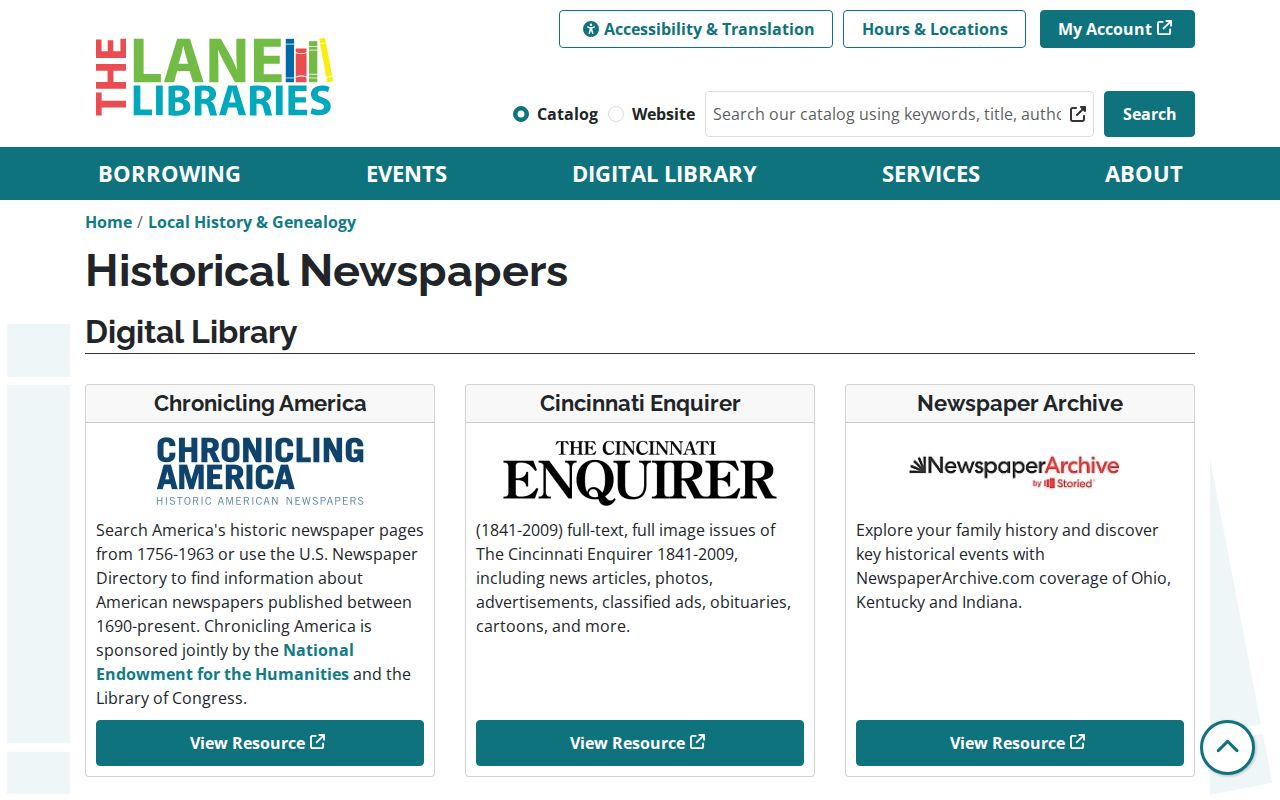
Use the collection display to identify the exact title and date range before asking for a notice, obituary, address reference, or local event. A newspaper item is a dated lead, while the directory entry remains a separate dated observation.
Fairfield Township City Directories and Newspaper Runs
A directory can place a person or household at an address for one publication year. The local print record helps fill the spaces between those snapshots. The Fairfield Echo ran from 1956 through 2013, with Lane holdings split between microfilm for 1970-1981 and 1987-2013 and a digitized segment for 1982-1987. The short Fairfield Journal-News route adds 1973-1974 through NewspaperArchive and 1978-1979 in Lane’s microfilm and digitized holdings.
For earlier county context, Lane reports Hamilton Intelligencer microfilm from 1828 through 1862, while Ohio Memory’s newspaper collection lists digitized Hamilton Intelligencer material for 1828-1856. The Venice Graphic gives another nearby historical route, with microfilm from 1887-1912. These titles can reveal spelling variants, a move, a death notice, a school or church reference, or the place label used at the time. Missing issues and unconfirmed title coverage should be checked with the holding repository.
Fairfield Township Directory Labels After 1954
A political change explains many difficult city directory searches here. In 1954, the southern portion of Fairfield Township became the City of Fairfield, while northern and certain southern areas remained township. Older sources may therefore describe a vicinity as Fairfield Township, Fairfield, Hamilton, City of Fairfield, or another postal place. The location label belongs to the record’s date, not necessarily to a modern map.
Start a search with more than one label. Keep the road or route, nearby cross street, legal subdivision or parcel identifier, and the date beside each name variant. This is especially important around the retained southern area, Georgetown and East River roads, and the State Route 128 area. The choice of postal label, fire provider, court territory, and township boundary can differ. A failed search under one heading is a reason to try the other documented labels, not proof that the household was absent.
Reading a Fairfield Township City Directory Record
Read the whole entry and the front matter before drawing a conclusion. A local volume may show a surname and given name, spouse notation, listed affiliation or occupation, street address, householder or status mark, and abbreviated references. The fields are useful only in the context of that particular publisher and year. No accessible local volume supported a claim that every Hamilton or Fairfield directory used the same symbols, so the year’s own key controls the interpretation.
| Publication details | Title, publisher, year, and page make the entry repeatable. |
|---|---|
| Name line | Capture surname, given name, initials, and any spouse notation exactly as printed. |
| Listed affiliation | Record the occupation, organization, or other affiliation only as the volume presents it. |
| Address line | Keep the street number, street name, and any residence notation as a dated address observation. |
| Status marks | Copy householder, ownership, widowhood, or other symbols, then consult that volume’s abbreviation key. |
- Criss-cross directory
- An address-ordered directory section that may connect a street address to a listed occupant for that publication year.
- Householder index
- An index arranged around the named head or listed household contact, not a complete account of all people at the address.
- Abbreviation key
- The publisher’s explanation of initials and symbols, usually found in the volume’s introductory pages and worth photographing with the entry.
Butler County Sources Beyond City Directories
When the library shelf has a year gap, the Butler County Historical Society collection highlights point to early marriage compilations, census data beginning in 1803, obituary, marriage, and divorce clippings, military material, and the Hamilton Journal-News morgue and photo archive. These are research leads that can test a name, date, or relationship suggested by a directory. Ask about the specific collection and access process rather than assuming remote access or a complete index.
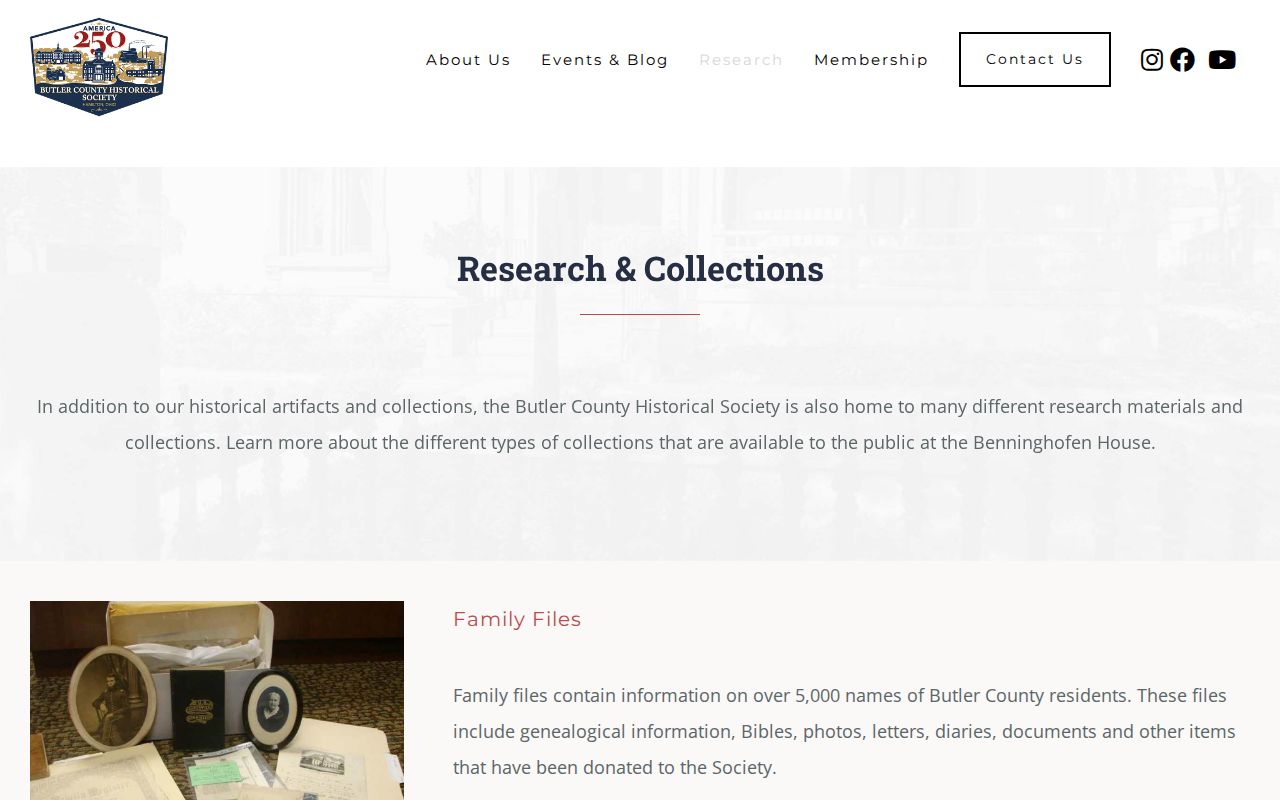
The Historical Society’s collections broaden the evidence trail when an annual listing is missing. They do not turn one directory entry into proof of every household member or a continuous residence history.
Trace a Fairfield Township Household Through Directory Years
Household tracing works best as a sequence of dated checks. Begin with a year that already has a name or address, then move in manageable intervals. Compare spelling, initials, spouse notation, affiliation, and street address before treating two entries as the same person. If a reverse or criss-cross title is held for the period, use it to test the address-to-occupant connection. For a modern address-record chain, use the Fairfield Township street directory rather than assuming a historical directory shows present occupants.
- Ask Lane staff for the relevant Hamilton, Fairfield, Fairfield Township, telephone, or reverse-directory title for the target date.
- Record the title, year, page, full entry, and abbreviation key before searching another volume.
- Follow the same name and address through later or earlier available years, marking moves and spelling changes.
- Pair the dated directory observations with the nearest released federal census, which becomes public 72 years after census day.
- Use a deed transfer, obituary, probate index, map, or newspaper notice to investigate a move, death, or gap.
Disappearance has several possible explanations. The household may have moved, a name may have changed, the person may have died, or the title may not have listed that address or person. Treat the next record as a test, not as an automatic answer.
Fairfield Township City Directory Access Paths
Online material is only one channel. Lane accepts research requests and supplies the local-history starting point for directories, yearbooks, maps, property histories, newspapers, and Fairfield history. Smith Library offers the in-person paper and microfilm route. The Historical Society is a separate route for its own census, clipping, vital, military, and photo holdings. Ohio Memory can supply digitized newspaper material, but its catalog should be checked for microfilm or hardcopy outside the online span.
For a document that needs an official copy, archival discovery and government custody are not the same task. Butler County Records Center and Archives stores inactive county material, but the office that created a county record remains the source for access decisions, redactions, explanations, and certified copies. Use the library or archive to identify a likely date, title, page, or record series, then contact the named government custodian for the official record.
Limits of Fairfield Township City Directory Research
City directories are historical indexes, not a census of every person. A listed address, affiliation, or status mark reflects what that volume recorded at that time. Historical residents who were not included, addresses that changed labels, and missing publication years all leave gaps. The strongest local method is to preserve the exact citation, identify the source type, and compare more than one independent record.
Lane’s directory category, Fairfield newspaper runs, Historical Society collections, maps, yearbooks, probate indexes, and released census records supply complementary evidence. They also have separate dates and access rules. Keeping the source date and locality label with each finding produces a clearer family-history trail than forcing every result into a single modern Fairfield Township description.